
Bienvenue dans WordPress ! Ceci est votre premier article. Modifiez-le ou supprimez-le, et lancez votre blog.
FRTB – Trading Book and Banking Book
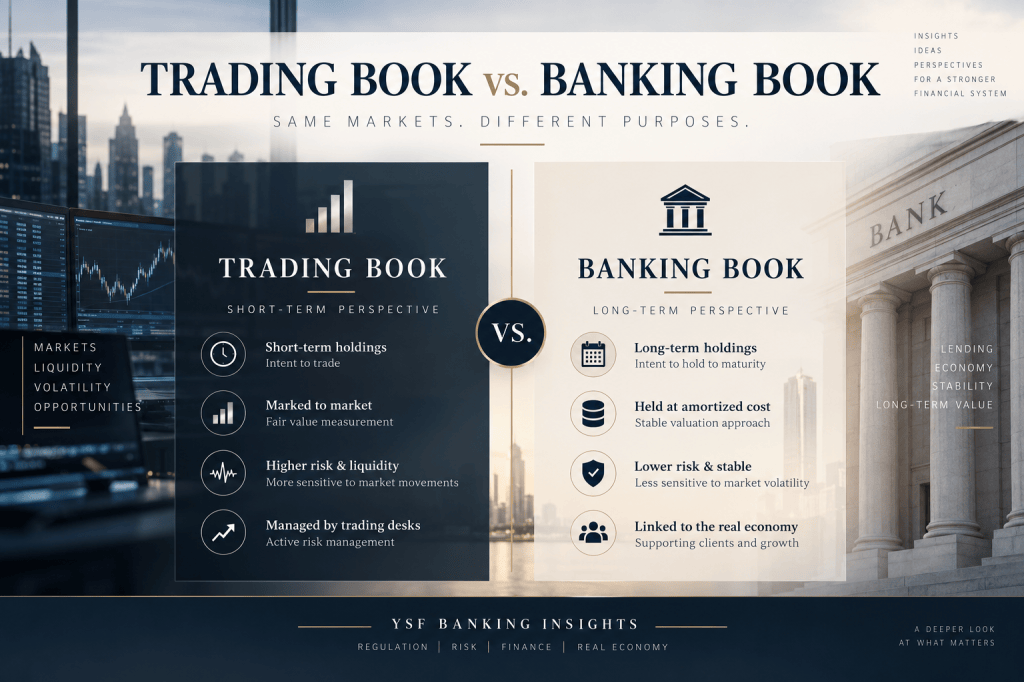
The Fundamental Review of the Trading Book (FRTB) has strengthened and clarified the boundary between the trading book and the banking book.
Objectives
- Prevent opportunistic regulatory arbitrage between the trading book and banking book aimed at reducing regulatory capital requirements.
- Better align regulatory capital requirements with the economic nature of market risk.
- Reduce differences in risk-weighted assets (RWAs) across comparable portfolios.
- Strengthen management accountability through clear and restrictive reclassification rules.
- Facilitate supervision and enhance transparency.
The trading book is primarily characterised by the intent to trade positions.
A position may therefore be allocated to the trading book where the bank intends to resell or close the position in the short term rather than hold it to maturity.
For example:
- Purchase of a 10-year US government bond with the intention of selling it before maturity → Trading Book
- Purchase of a 10-year US bond with the intention of holding it to maturity → Banking Book
Classification under the FRTB
The FRTB framework establishes conditions under which instruments are expected or required to be allocated to the trading book. These include, among others:
- Positions held with short-term resale intent.
- Positions held with the intention of benefiting from actual or expected short-term price movements.
- Instruments managed on a trading desk.
- Instruments resulting in net short equity or credit positions.
- Instruments used to hedge risks arising from trading book positions.
Instruments that do not meet the relevant trading book criteria are generally allocated to the banking book, subject to the specific classification requirements and presumptions established under the regulatory framework.
Examples of Instruments
Trading Book
- Listed equities, subject to applicable regulatory requirements and permitted exceptions.
- Investments in funds meeting the relevant look-through and valuation requirements.
- Trading-related repurchase agreements (repos).
Banking Book
- Real estate holdings.
- Unlisted equities.
- Retail and wholesale customer loans.
- Investments in funds that do not meet the relevant trading book eligibility requirements.
- Derivatives used to hedge banking book positions.
The FRTB clarifies and strengthens the boundary between the trading book and banking book to ensure that regulatory capital requirements more appropriately reflect the underlying risks, limit regulatory arbitrage, and enhance the transparency and discipline of banks’ trading activities, notably through the Basel framework’s disclosure requirements.

