
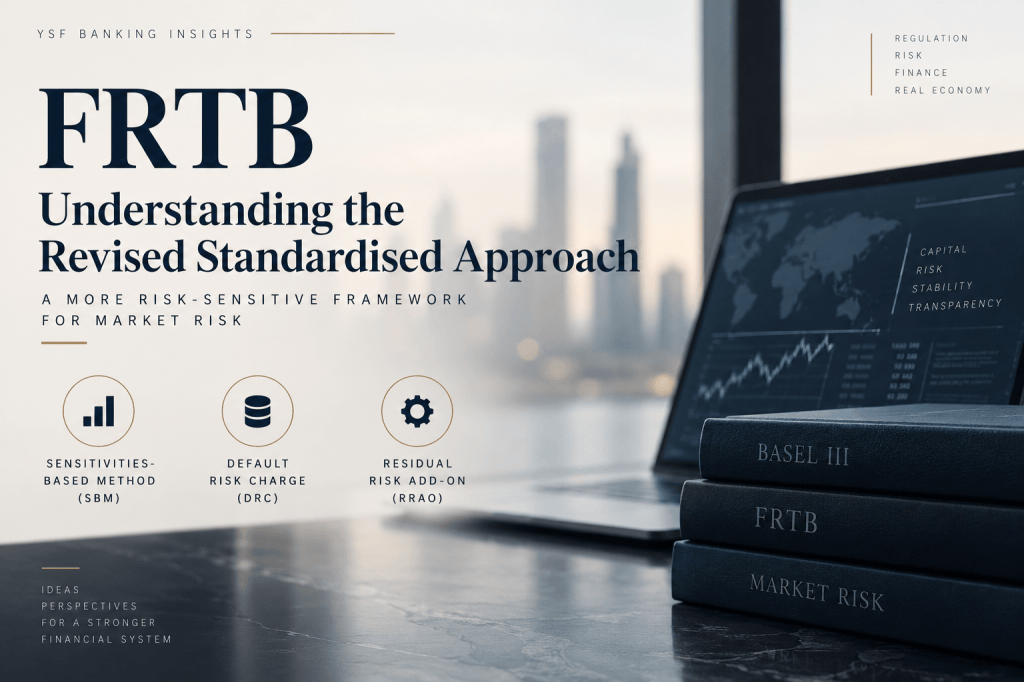
The FRTB framework has fundamentally redesigned the standardised approach to make it more risk-sensitive and better aligned with the underlying economics of market risk. Under this framework, banking institutions are required to calculate and report their capital requirements to supervisors on a monthly basis.
Capital requirements under the revised standardised approach are based on three main components:
- Sensitivities-Based Method (SBM)
- Default Risk Charge (DRC)
- Residual Risk Add-On (RRAO)
Sensitivities-Based Method (SBM)
The SBM covers seven risk classes and is based on the aggregation of Delta, Vega and Curvature risk measures.
- Delta risk: exposure to changes in an instrument’s value resulting from movements in underlying risk factors, such as interest rates, equity prices and other market variables.
- Vega risk: exposure to changes in implied volatility.
- Curvature risk: captures the incremental risk arising from non-linear changes in value that are not captured by Delta risk.
Residual Risk Add-On (RRAO)
The RRAO applies to instruments exposed to residual risks that are not adequately captured by the SBM, particularly instruments with exotic underlyings or other residual risks.
The applicable capital requirement is determined as a percentage of the instrument’s gross notional amount, with the prescribed risk weight depending on the nature of the residual risk.
Default Risk Charge (DRC)
The DRC captures the risk of losses arising from default events. It applies notably to:
- Debt and equity instruments.
- Derivatives referencing such instruments.
- Derivatives whose value is affected by the default of an issuer other than the derivative counterparty.
The underlying calculation mechanisms and practical illustrations are presented in the accompanying carousel.

